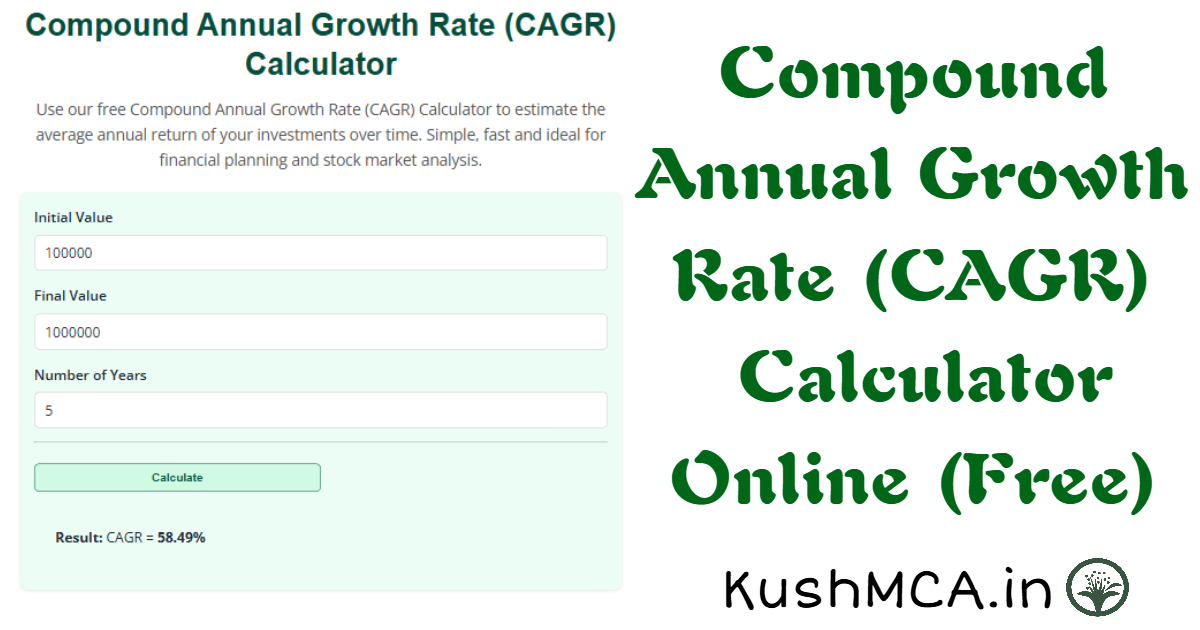
Learn how a CAGR calculator helps measure true investment growth over time with simple examples.
Link copied to clipboard!
Researched and written using standard financial formulas and the available article context.
Turn this guide into numbers with: SDP Calculator - Interest & Maturity Value | SIP Calculator - Monthly Investment Returns | EMI Calculator - Loan Monthly Payment
Investment conversations often sound confident on the surface. Someone mentions how much their portfolio has grown, another compares entry and exit values, and the discussion moves on. What usually gets missed is how uneven that journey may have been in between.
A common mental shortcut is to judge performance only by the start and end points. This feels intuitive, but it quietly ignores time, volatility, and the pace at which growth actually happened.
The gap between perceived growth and actual growth is subtle, yet it shapes many long-term decisions without being noticed.
Understanding growth without overcomplicating it
Investment growth is rarely smooth. Values rise, fall, recover, and sometimes stagnate before moving again. Looking at the overall outcome without considering the time taken can create a distorted picture.
Thinking in terms of an average annual pace helps translate an irregular journey into a single, comparable measure. It does not describe every year perfectly, but it captures the underlying rhythm of growth.
Why people often misread performance
Humans are drawn to absolute gains because they are tangible. Doubling money sounds impressive, regardless of how long it took. Time fades into the background unless it is made explicit.
This is where most people get surprised. Two investments with the same final value can represent very different growth experiences once duration is considered.
Why this measurement matters in real decisions
Evaluating performance influences whether an investment feels worth holding, exiting, or reallocating. Without a time-adjusted perspective, decisions are based on incomplete signals.
When you calculate it properly, comparisons become fairer. It becomes easier to judge whether an outcome was efficient or simply prolonged.
The impact of time and small differences
Time acts as a multiplier in subtle ways. A small difference in annual pace can compound into a large gap over longer periods. Conversely, strong short-term gains may lose significance if stretched across many years.
When you calculate it, the pattern becomes clearer. Duration transforms how gains should be interpreted.
A realistic investing situation
Consider someone reviewing two past investments. One shows steady appreciation with few fluctuations. The other had sharp rises and falls but ended at a similar value.
Looking only at the final amount suggests they performed equally. Numbers often reveal what assumptions hide when the time element is applied consistently.
Common mistakes that cloud judgment
- Comparing investments without aligning time periods
- Focusing only on total return instead of annualized pace
- Ignoring long flat or volatile phases in between
- Assuming recent performance defines long-term quality
These errors usually come from oversimplification, not lack of intent to understand.
How this differs from related measures
Point-to-point return shows where you started and where you ended. Average return often assumes smooth progression. A compounded growth view bridges these gaps by respecting both value and time.
This makes it especially useful when comparing investments with different holding periods or uneven paths.
Using the calculator as a thinking aid
The calculator works best when used to test understanding rather than chase precision. Adjusting start value, end value, or duration helps reveal how sensitive outcomes are to time.
Exploration builds intuition. Instead of guessing whether growth was good or average, clarity emerges through consistent measurement.
The psychological side of measuring growth
Clear metrics reduce emotional bias. They prevent overconfidence after short-term wins and unnecessary disappointment after slow but steady progress.
Clarity encourages patience. When growth is viewed through a time-aware lens, decisions feel calmer and more deliberate. Trying different scenarios using the calculator supports long-term thinking and reinforces confidence grounded in understanding rather than assumption.
Related Articles
View allTrending Articles
- Ring Fence Calculator Explained: How to Protect Your Financial Goals
- Compound Interest Calculator: How Your Money Grows Over Time
- How to Split Loan EMI Between Co-Borrowers: Calculator & Examples
- CAGR Calculator Guide: Measure Real Investment Growth Accurately
- EMI Split Calculator Explained: Split Loan EMIs Equally or by Custom Percentage
- RD Ladder Calculator Explained: How to Build a Staggered Savings Plan